Trigger Warning: For those of us who love language and don’t like to see it treated with cruelty, the following post contains some upsetting material, in which several rules of good writing are broken. The post also features adverbs from the beginning.
‘It’s about time I wrote a blog post,’ I thought to myself, tiredly, as the bright sun peaked over the flat horizon to signal a crisp, Autumn morning.
So I sat down at my computer, reluctantly, pondering whether to write about one of those thrillers I had enjoyed so much recently, or whether to dive enthusiastically into some other subject matter, such as my love for the wonderful Anthony Trollope, the famed Victorian writer who wrote so prolifically.
As I sat there, thinking about what to write, I took a sip of coffee from the big mug in my hand. I slurped the hot liquid greedily as an idea struck me. I began writing furiously, putting down all my thoughts on that favourite topic of writers: the techniques and building blocks of writing.
Suddenly there was a knock at the front door. I looked out of the window, curiously, to see who the visitor was. It was a young man in a black coat. He had a medium-sized beard and brown eyes. He stood at the door impatiently, a parcel in his hand.
‘What’s this?’ I said to myself, quietly. ‘I don’t remember ordering anything.’ Then a thought sprang energetically into my head. Of course! I had recently ordered the book The Elements of Style, along with Stephen King’s On Writing. But why, I asked myself, frowning deeply, didn’t the delivery driver just post it through the door?
I opened the door angrily, unhappy at being interrupted. The delivery driver stood there sheepishly, holding the parcel. ‘Your letterbox is very small,’ he said earnestly through his medium-sized beard. ‘I tried to push it through but it kept getting stuck.’
‘Don’t worry,’ I said, kindly.
Suddenly I saw the parcel which he was reluctantly proffering. In his aborted attempt to put the parcel through the letterbox, he had damaged the package. What was left was a mangled and misshapen duo of books, contorted and ugly.
Isn’t it awful, I thought to myself, sadly, when someone takes something great, like printed words, and turns it into a complete mess? I promised solemnly not to be guilty of such a crime.
The Portuguese town of Póvoa de Varzim is a short tram ride from Porto. Its beach is popular on sunny days, its outdoor café terraces bustling with day trippers who have taken the red line tram north to escape the city. Tourist shops selling buckets, spades and parasols can sit alongside small shoe repair shops (sapatoeiras) for locals, and overdeveloped blocks of flats are just round the corner from elegant, historic squares.
In 1845, Eca de Queiros was born in Povoa de Varzim, which at the time was little more than a fishing town. Eca de Queiros is a well-known name in Portuguese literature, and indeed outside of it. His name is known within Portuguese culture in general, and his famous novels, such as Os Maias and The Crime of Father Amaro, are the kinds of books that meet Alan Bennett’s famous definition of a classic: a book everyone thinks they have read, but probably have not.
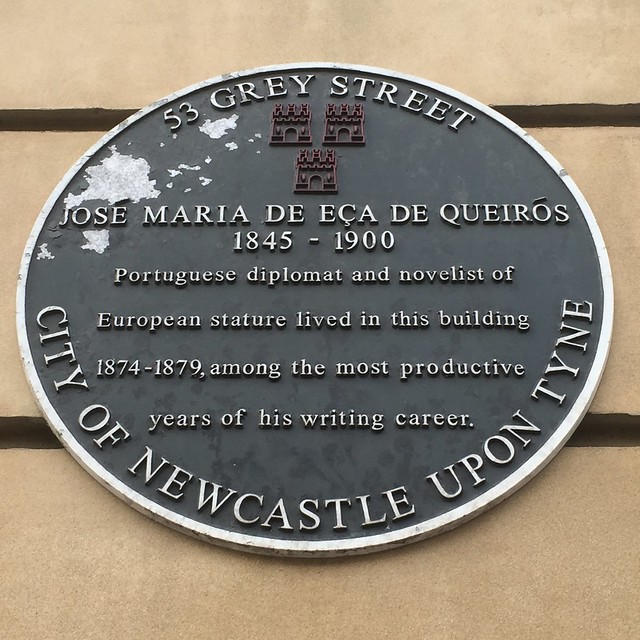
A curiosity in both the histories of Portuguese literature and the city of Newcastle, is the fact that Eca de Queiros spent five years living at 53 Grey Street in Newcastle. He travelled widely during his career as a diplomat, and held posts in Havana, Bristol, Newcastle and Paris (and it’s not often those four places are named together). At the time both Bristol and Newcastle were key port cities, made prosperous by trade, and in the case of Newcastle, coal mining.
I would love to know how many people notice the plaque on the great Georgian thoroughfare of Grey Street, as they walk from the Metro station towards Tyne Bridge and the river. It seems to me that it represents an obscure chapter of history which can become easily lost.
For an English reader, some of Eca de Queiros’ books are available in translation, but they would have to be sought out. He is basically unknown in the English-speaking world. I have read various of his short stories in Portuguese, and own a copy of his detective novel, which I have written about in a previous post. Despite his admiration for Dickens, Eca de Queiros was never going to find such popularity himself. This is partly, in my opinion, because his books are just not as commercial or engaging as Dickens’, and also because as a Portuguese-language writer he had a much smaller market.
Even today, the highly respected and award-winning writer João Tordo comments on the difficulty of being a Portuguese-language writer. Or, as he put it, a writer in a country where reading isn’t such a popular past time. There is, of course, the fact that as Portugal has a population of 11 million, a Portuguese-language writer would need to hit the Brazilian market to reach big numbers in their native language.
I would recommend Eca de Queiros’ birth town of Póvoa de Varzim if you are ever in Porto and fancy a day trip to the beach. It is only a tram ride away. These are not, however, the tranquil beaches of the southern Algarve. It is the rough Atlantic coast of the north. It makes me wonder, considering the harsh but beautiful English north-east coast, whether Eca de Queiros might have felt somewhat at home in Newcastle after all?
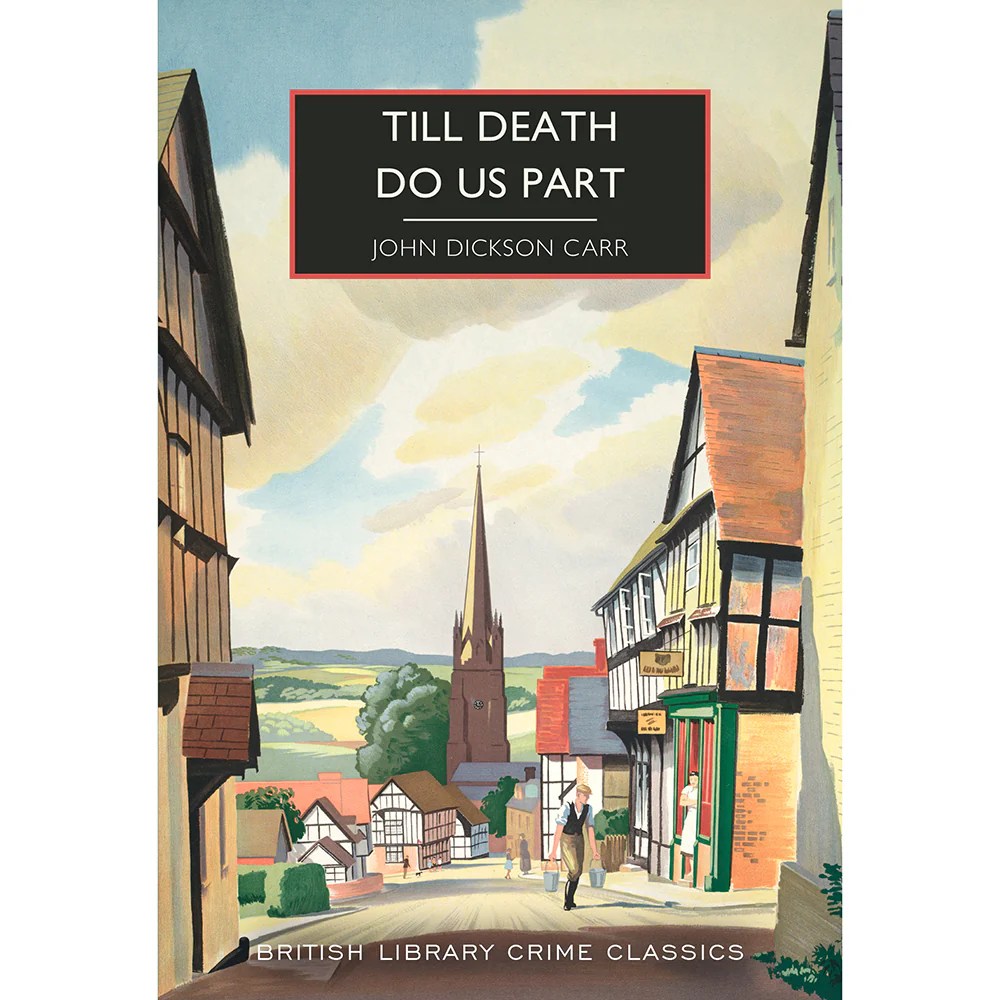
John Dickson Carr (1906-1977) was the king of the impossible crime story, or the locked-room mystery. This sub-genre of crime is just as much about how it was done than who committed the crime. A body is found in a room which is locked from the inside. How did the killer enter and leave? This is the type of story in its essence.
The number of impossible crime scenarios a writer can come up with is endless. However, once an impossible crime is thought up, a plausible solution must also be worked out, and this is the challenge for the writer. If a writer writes himself into a corner, he must write himself out if it again.
I have to admire John Dickson Carr’s clever plotting. I also enjoy the darker and more sinister details he adds, which sometimes hint at the supernatural. In The Hollow Man a man leaves no footprints in the snow before vanishing, and there is a hint that someone has come back from the dead. The settings are often old castles and houses, which add a touch of the gothic. John Dickson Carr made the impossible crime his speciality, creating intricate and clever plots to amaze readers and confound their expectations. However, there is a ‘but’ coming…
At its worst, I find Dickson Carr’s writing clunky and confusing. Sometimes characters say odd things, sometimes scenes are described in such a way that the reader has to read it again to understand exactly what’s going on. The reader of crime novels should find the mystery taxing, not the prose style. Many of the characters are two-dimensional (the pretty young woman, the man-about-town, etc).
Another problem Dickson Carr has is that his characters aren’t likeable (of course, I’m writing subjectively, and others may disagree). Take his detectives Gideon Fell and Henry Merrivale. Both are bumbling and sometimes cantakerous, but neither is very endearing. Contrast this with Poirot, who is conceited and absurd, but also a reassuring presence who we like, despite all his eccentricities. When Poirot shows up half way through Sad Cyprus, the reader feels they are on safe ground all of a sudden. Here comes Poirot, and everything is going to be all right. When Henry Merrivale turned up to solve the crime in The White Priory Murders, with sexist comments and ill humour, I didn’t get such a feeling.
John Dickson Carr’s plots are sometimes brilliant, and its on this that his reputation rests. His short story ‘The House in Goblin Wood’ gives us a mystery about a girl who goes missing from a house, and then reappears again without explanation. Years, later in adulthood, she revisits the house, and goes missing from a locked room once again. The story is intriguing, macabre, and ingenious in its plot. There is an explanation, and a clever one at that. (I will apply my previous criticisms to this story: the central detective – in this case Henry Merrivale – acts erratically, and the other characters say and do odd things which brought me out of the story.)
The author’s most famous book – and the most famous of all locked-room mystery stories – is The Hollow Man. This has John Dickson Carr’s regular mix of ingenious plotting and macabre story elements. I have read and enjoyed this book recently. However, it wasn’t my first attempt. I have a memory of being fifteen years old, lying on top of a canal boat one summer, trying to get into this book, but struggling to. I eventually gave up. More recently, I gave up on an audiobook of DeathWatch, which starts with the murder, but just throws all the characters and clues at you in the first chapter, which doesn’t draw the reader into the story.
I believe that this obstacle is one that has prevented John Dickson Carr from being a truly popular writer. He is very well known among fans of crime fiction, but his popularity has not reached as far as some of his contemporaries (think Christie, Sayers, Chesterton, etc) who were read by readers who only dabbled in reading the genre. John Dickson Carr’s books are for crime fans. I recently read The Honjin Murders by Seishi Yokomizo. This Japanese crime novel from 1973 explicitly mentions John Dickson Carr in the text, and delivers its own locked room mystery. He is also referenced in subtle ways in the series Jonathan Creek, written by David Renwick, a lifelong fan of the locked room mystery. As I’ve mentioned it, I must recommend Jonathan Creek not just as a series of fantastic locked-room puzzles, but as a generally entertaining series (with charming, likeable characters, and some great gags).
I have titled this piece ‘The Impossible Case of John Dickson Carr’ because he leaves me with a conundrum. I love impossible crimes and intriguing, macabre mysteries. But I am constantly frustrated by his awkward scenes and odd dialogue. I enjoyed The Seat of the Scornful, and also The Black Spectacles, which is a personal favourite of mine among his books. I will continue to read John Dickson Carr, but I am left with the feeling that although I admire the mysteries (indeed, I am inspired to write my own locked-room mystery), I will never warm to his world as I have to the worlds of other writers. Dickson Carr has wit, he has plot ingenuity, but he lacks a common touch, the ability to draw any reader into his books.
Of course, this is subjective, and a true John Dickson Carr fan may put a wonderful case forward for him. I will keep reading his books (I notice that the British Library crime series have at least one more coming next year), and I will continue to be impressed by his plots. But he will never be a writer I am truly fond of, only one I admire. Perhaps that is enough.
Note: The crime fan and pedant in me would like to point out a common mistake. A ‘locked room’ mystery is not the same as a ‘closed circle’ mystery. Even crime writers themselves mix this up sometimes (I won’t mention names!) A ‘closed circle’ mystery is where the murderer can only be one of a certain number of people (think And Then There Were None). A locked room mystery is an impossible crime, a crime in which the murderer has seemingly miraculously entered or left the scene of the crime.
Earlier this year, I spent a few days on the Lisbon coast. I stayed in Cascais, one of the towns along the so-called ‘Portuguese Riviera’, a stretch of coast whose beautiful beaches, south-facing aspect, and frequent sunny days make it a popular holiday destination.
I walked around its cobbled streets, walked across wide-open popular beaches, discovered hidden beaches in coves and gaps in the rocks, which led to secluded caves. These are the moments when the writer thinks ‘I could write a story set here.’ It’s a moment of excitement, a rush of creative possibility. As writers, we are drawn to such magical places – we ask the ‘What if…’ question, and a story emerges like a beautiful image not yet in focus. The characters, drama, and suspense are all there to discover.
The inspiration part is a beautiful period. Endless possibility, unlimited potential. But then comes the perspiration. Back home, away from the Portuguese sunshine, away from the chilled wine and the sound of waves lapping against the rocks, I have to sit down and write 80,000 words. No amount of dreamy ‘What ifs…’ will carry me through this task. Work, work, work. Write, write, write. That’s what it takes to make the wonderful ideas we have as writers into a novel that works. Maybe it won’t work at first. Then you have to fix it. That mean’s more work, more problem solving.
The dreamer says to himself ‘I could write a book set here.’ The writer gets the job done. It’s something we might struggle with a first, but practice and determination pay off. Look at all the writers filling up the top positions in the bestsellers charts. They all began by thinking to themselves, ‘What if…’, before getting to work and finishing the book.
Like most readers, the writers I regard as my favourites can change from year to year. In my early twenties I read almost everything by Somerset Maugham, which has certainly influenced my approach to writing prose. Agatha Christie is a writer I have repeatedly returned to ever since first reading her as a teenager. Last month I decided to read Sleeping Murder, one of the few Marple books I hadn’t yet read.
I was surprised when a character called Walter Fane was introduced. In the story, he is a lawyer who once proposed to Helen, the murder victim. She had accepted before changing her mind. Is this, we are made to wonder, a motive for murder? Here is the strange thing: Walter Fane is also a main character in Somerset Maugham’s novel The Painted Veil. Maugham’s novel was published in 1925, around fifteen years before Christie wrote Sleeping Murder. The Painted Veil is the story of an unhappily married British physician living in Hong Kong. His wife regrets her hasty decision to marry him. When she is unfaithful to him, he decides they should move to a village where there has been a cholera outbreak, a potentially perilous decision for them both.
The two Walter Fanes are not dissimilar. Both are colonial types – one in Hong Kong and the other in India. They are both buttoned-up men who are not emotionally forthcoming. One proposes marriage to a free-spirited woman who says yes and then changes her mind; the other proposes marriage to a free-spirited woman, who replies “I suppose so,” but finds the marriage dull. In other words, both Walter Fanes inspire tepid responses from their love interests. In Christie’s book this makes the character a good suspect; in Maugham’s it makes him out-of-step with his vivacious wife. Maugham was good with character names. ‘Fane’ has connotations of weakness. I remember another Maugham character called McPhail, the homonym of ‘fail’ being an appropriate connotation for the character.
The question is this: Why did Agatha Christie use the name Walter Fane? Christie was well read and in touch with the literary and theatrical landscape of the first half of the twentieth century. Maugham was a playwright as well as a novelist. In fact, in their day, Maugham and Christie were two of the most popular playrights in the West End. Maugham bowed out of writing for theatre at about the time Christie started.
There are several references in Christie’s books to other writers, sometimes introduced with subtlety. In Hercule Poirot’s Christmas the butler talks about the experience of deja vu, the feeling that you have lived something before. He mentions a play in London that was about that subject (but does not name it). The play is likely to be J.B. Priestley’s ‘I Have Been Here Before’, which opened in London in 1937, a year before Christie published Hercule Poirot’s Christmas. I imagine Christie had seen the play, and its theme was fresh in her mind as she wrote Poirot’s Christmas mystery.
This brings us to the subject of the mind. As a writer myself, I know that sometimes I have to make up something on the spot, dive into my mind for some fabricated detail. It is plausible that when Christie did this as she was writing Sleeping Murder, she came up with a name which had been stored in some unconscious part of her mind. Walter Fane sounded like a good name for an emotionally repressed Englishman living in a British colonial outpost…because it already was the name of such a character. The fact that they are similar characters may have been a factor. I certainly doubt that there was anything intentional about it.
For the prolific writer, names are always an issue. Christie’s books often contain large casts (remember the twelve suspects on the Orient Express?), and with eighty or so novels, we can speculate (we won’t actually calculate) that Christie invented over a thousand names. On this occasion, a name slipped through from a book she had read a few years before. Sleeping Murder was written in the 1940s, but not published until after her death in the 1970s. I wonder whether, had it been published in the time when it was written, an editor might have pointed out to her the coincidence? By the time readers had the chance to read Sleeping Murder, Agatha Christie had died.
There is a further intrigue: Maugham’s Walter Fane was meant to be called Walter Lane, until legal trouble from a couple by the name of Lane living in Hong Kong forced the change. The change from Lane to Fane was an obligation.
Of course, this takes nothing away from the great lady herself. Of the two novelists, Maugham’s Fane came first, but Christie’s Fane is likely to be around for a lot longer.
Finally, I would like to recommend two brilliant biographies of each of these writers: Agatha Christie by Lucy Worsley, and The Secret Lives of Somerset Maugham by Selina Hastings.
Whenever I listen to interviews with authors, I’m always interested to know their writing routines. I think this is of interest to both established and aspiring writers. When you start off with the aim of getting 80,000 to 100,000 words from your brain onto the page, the obvious question is ‘How shall I do it?’
Closely related to this are the questions ‘How many words can I write a day?’ and ‘How long does it take to write a book?’
The writer of commercial fiction is often contracted to publish a book a year. This means he or she may be writing the first draft of one book, while editing another book, and publicising yet another! You may wish to be a commercial genre writer, or you may wish to be more like James Joyce, who spent years on a book (and reportedly could spend a whole day on one sentence). Or Donna Tart, who has written few books, with long gaps in between, but has consistently been critically and commercially successful. What kind of a writer do you want to be?
The first full-length novel I wrote (and it’s one of those novels which will stay in a draw for now) was an historical novel of 140,000 words. It was too long, but I did get a manuscript request from an agent, which suggests it wasn’t awful. During the process of writing this book I learned how best to get words on the page, and what kinds of routine suits me.
During this time, my wife was working shifts at a local hospital, which meant sometimes she would have to start work at 7am. I got into the habit of getting up early with her, and using that time in the morning to write until I had to go to my own job for 9am. I found that I was never more productive than at this time in the morning. Even on days when I had a large block of time in, say, the afternoon, I seemed to lack the flow and clarity I found first thing in the morning.
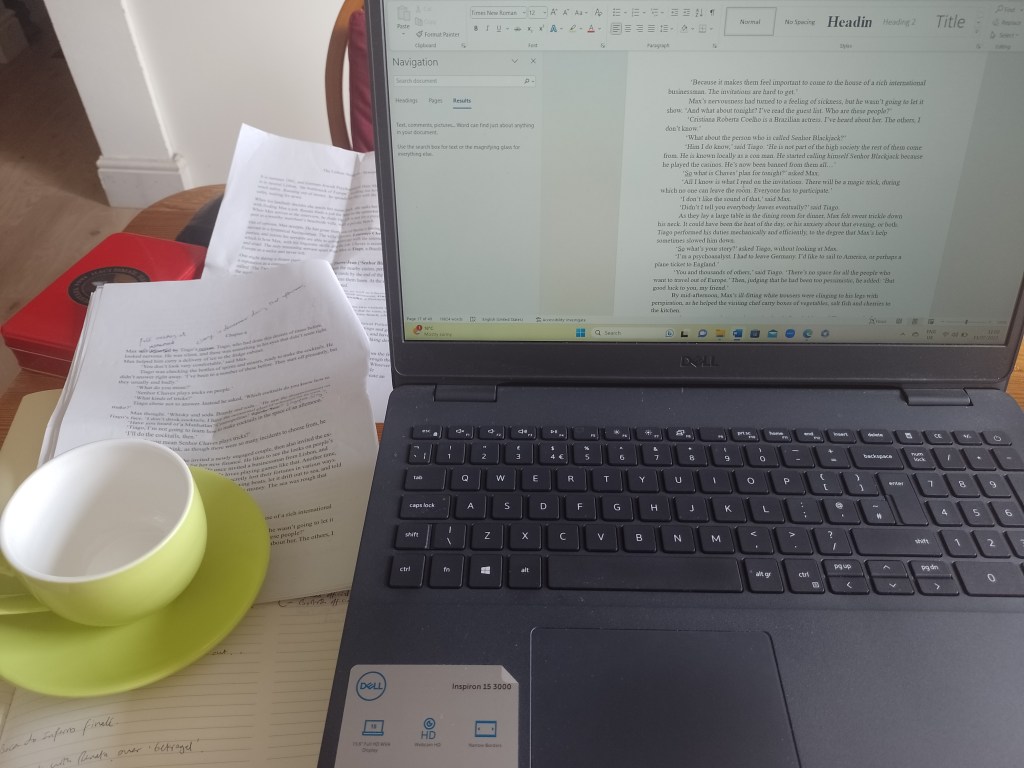
Thus, my writing routine was set. For some reason, I use a particular lime green cup and saucer on writing mornings, filled with strong black coffee. I wouldn’t call it superstition, but rather there’s something about the ritual of a routine that I’d prefer not to change if it works.
As I learned to rewrite and redraft, I found that this detailed work was best saved for later in the day. Early morning was where I found the creative spark, but not necessarily when I had the keen eye for detail needed for editing.
Famously, Anthony Trollope would write in the mornings before he went to his job at the Post Office. He would write 250 words each 15 minutes. Writing between the hours of 5:30am and 8:30am, that put him at around 3000 words per day. I heard an interview with Linwood Barclay, who during the writing of a recent novel found getting an Uber into town gave him a surprisingly productive time and place for writing. So during the writing of that book, he kept getting Uber rides into town.
I think another reason writers want to know about other writers’ routines is that we are insecure and want to compare ourselves. We ask ourselves the question, ‘Are others writing more than I am?’, or ‘Do other people find it as hard as I do?’ This suggests that no matter how experienced or professional a writer is, there is always a part of them that doesn’t know what they are doing. Creative processes are mysterious. It’s not like changing a bike tyre, or altering your boiler pressure, with step-by-step videos available on youtube.
Whatever you find works, whether it’s early in the morning or late at night, the key is consistency. If you are sporadic, or can’t find a routine, that word count will stay low. If you can get into a habit, even if you write a little at a time, you will be surprised at how the word count goes up and reaches your target.
I’ve written before about how the streets and houses in a place like Oxford have echoes of its literary past in hidden corners and unexpected places. Tolkien’s large family home on Staunton Road; Lewis’ semi-rural house on the edge of Headington (at least it was semi-rural when he lived there); the stone house down a leafy side path in Headington Village where Elizabeth Bowen lived until her 1935 move to London; the old limestone house on Brewer Street where Dorothy L Sayers was born.
Last week I stumbled across another tribute to a writer, but away from the respectable, leafy suburbs, or the elegant College residences. Near the bottom of Cowley Road, on a Victorian house of three levels, is a stone tribute to Edward Thomas. The house is nothing special to look at – weeds growing between stone cracks at the front of the house, and modern PVC windows fitted unsympathetically into spaces designed for wooden sash frames. Like many properties around there, it is probably divided up into student flats and let out at high prices.
To anyone who lives in Oxford, the words ‘Cowley Road’ will bring all sorts of connotations. I lived between Cowley and Iffley Roads for a number of years. The most common adjective is ‘vibrant’, which is a vague word often used euphemistically, both positively and negatively. The road is known for its festival, for its international cafés and restaurants. It has been a place for first-generation immigrants, but also a hang out for drug users and people on the fringes of society. As a result, if you spend any time on the Manzil Way area of Cowley Road, you will observe a curious and incongruous mix of observant Muslims walking to mosque, and down-and-out drug addicts grouping around the benches near the children’s play area.
Edward Thomas is a writer I stumbled across when I read some of his short stories. Next I read his poetry. He is famous for his poetry about the English countryside, and also famous for his death in the First World War. His poem Adlestrop is particularly beautiful, because it captures a quiet moment. One late June, a train stops at a small village station on the Oxfordshire and Gloucestershire border called Adelstrop (out of use since the Beeching cuts of the 1960s). No one gets off and no one gets on. It is, in other words, it’s a poem where nothing happens. But in that stillness, the details of sound and sight come to life. Far from nothing happening, the absence of activity allows the background features of the scene to come to the fore. As it is such a short poem I will include it below:
Yes. I remember Adlestrop—
The name, because one afternoon
Of heat the express-train drew up there
Unwontedly. It was late June.

The steam hissed. Someone cleared his throat.
No one left and no one came
On the bare platform. What I saw
Was Adlestrop—only the name

And willows, willow-herb, and grass,
And meadowsweet, and haycocks dry,
No whit less still and lonely fair
Than the high cloudlets in the sky.

And for that minute a blackbird sang
Close by, and round him, mistier,
Farther and farther, all the birds
Of Oxfordshire and Gloucestershire.
My walk along Cowley Road, and seeing that small, stone reminder of a past life in such an unexpected place reminded me of how the past, and the figures who peopled it, are around us if we are willing to notice.
The first Stephen King book I ever read was his memoir On Writing. He struck me as a writer who was dedicated not just to the art and craft of writing, but also to a life of reading. Alongside his passion for popular science fiction and horror of the 1950s and 1960s, his growth as a writer was equally fed by his love of Dickens and Trollope.
King’s story is one every writer dreams about. In the 70s, while working low paid jobs and making ends meet, he wrote his first novel, Carrie. Its rapid success made him both successful and financially secure almost overnight.
Fast forward a few decades and King is as prolific as ever. His new book, Holly, comes out later this year. Although he is known as a horror writer, he has recently been regarded (not least by his publishers) as a writer of thrillers. This may be a reflection of a shift in style, or it may be driven by the publisher. Thrillers sell. Horror is seen as a niche genre.
I recently read The Institute, which is full of some of King’s favourite elements: children with supernatural powers; jobs with night shifts; the daily lives of people on the fringe of US society; big questions about good and evil. King is evidence of the famous observation that a writer just writes the same book again and again. This is not meant negatively, but is rather an observation about how, perhaps unconsciously, a writer will return to the same material. I have read at least one review in a national publication which complained that The Institute featured themes King had already covered. I think this kind of criticism fails to appreciate the way that creative endevours draw on unconscious material. The writer uses ideas which spring into the mind. This is part of the mystery of creative work.
One of the impressive things about King is his creative energy. It’s not just that he writes long books (as he always did), but that he still has the “What if?” starting point that he would have had right back at the beginning. The Mr Mercedes series is evidence of this. It became a trilogy, the second of which, Finders Keepers, gave King the chance to explore the world of writers and readers, when the young protagonist stumbles across a manuscript which has both literary and monetary value.
King has written many novels about writing and the art of writing. I think it is a brave choice to do this, and aspiring writers should think hard before they make their main character a writer. It seems like naval gazing, like the writer has limited experience and so writes about the process they are in. Misery and The Shining famously have writers at the centre, but several other works do too (‘1401’, Finders Keepers, Dumas Key, etc). King makes a success of this, where other writers would have failed.
Over the years I have come back to King a number of times, constantly rediscovering him. He doesn’t stay still, and he doesn’t rest on his reputation. He keeps writing, keeps telling stories.
What is King’s secret to success? There isn’t one, except for the obvious. He read a lot, he writes a lot, he has always been interested in storytelling and words. As well as this, he has cared little for trends. An aspiring writer should write what they want to write and not try to ride the latest wave of popularity. If King had done that, he may have been finished years ago.
One of the joys of reading is to escape. Not just escape, but to have the chance to explore new worlds. I don’t often consider this aspect of reading. More often I point to my love for language or my interest in human psychology and behaviour. I also love story, which means I love the thrills of the plot racing forward, and the cliff-hangers that make us say “Just one more chapter!”
I always associated escape and the building of ‘literary worlds’ with science fiction and fantasy. In the corner of Oxford where I live there are no shortage of famous homes and landmarks with links to such authors. I regularly walk past J.R.R. Tolkein’s old house on my way to work. I used to walk past the grave of C.S. Lewis every time I took my daughter to pre-school, cutting through the grave yard of Quarry Church. When I go for a walk I often find myself walking past the entrance to the house of the late sci-fi author Brian Aldiss.
(I will add here a detail which will be shocking to Terry Pratchett fans. As a teenager I joined a huge queue at WH Smiths in Nottingham to get a book signed by Terry Pratchett. I was fascinated by all things bookish, and knew I wanted to write. To meet an actual writer was thrilling. I loved the illustrations on the covers of Pratchett’s books. However, I just couldn’t get into the books. They weren’t my thing. To this day I have a signed copy of Good Omens, which is inscribed with the words: “To Russell, We made the Devil do it! Terry Pratchett”. I’ve had it for over twenty years and have never read it.)
Fantasy and sci-fi were never my kinds of genres. Yes, I dip into Tolkein and dabble with John Wyndham, but I’m never at home with the genre. For me it is always crime fiction, thrillers, and sweeping Victorian novels. These are the books I immerse myself in. They are just as escapist and immersive as any other created world. When I read Georges Simenon, I am in Paris, joining Maigret for his lunchtime sandwich and beer. When I read Agatha Christie, I’m in the world of picturesque villages with dark secrets, or I’m entering Poirot’s world of glamourous holidays and seemingly endless leisure time (not to mention income).
The word ‘escape’ can have unhealthy connotations. To escape reality can be harmful, hence ‘fantasy’ being on Anna Freud’s list of psychological defence mechanisms. However, there is a difference between the reader knowingly entering a fantasy world and the person who is detached from reality in response to the threat of psychic pain. We must remember Coleridge’s phrase on reading: the ‘willing suspension of disbelief’. The reader knows the difference between fantasy and reality, and fully understands the tacit agreement with the author: “You tell me something as if it’s true, and I’ll believe it as if it’s true, even though we both know it is untrue.” I will add to this that poetic truth exists outside of literal truth anyway.
Which other worlds do I love to be immersed in? I read crime fiction set in various parts of Europe: Martin Walker’s books set in the Dordogne, Donna Leon’s Venice books, the Sicilian Montalbano books, Ragnar Jónasson’s Iceland books, Tom Benjamin’s Bologna books, Ian Rankin’s Edinburgh books, and the list could go on. These books give us a literary version of a real place, which is, I suppose, quite different from being in the place itself. We may get a strong cultural and geographic flavour of the setting, but where the line between fantasy and reality is, I don’t know. My own books, set in Portugal, offer an authentic sense of the city of Coimbra, but it will always be through my eyes and with my observations. I will people the city with characters I want to include, and will leave out the parts I have no interest in.
Since childhood I have been interested in Joan Aiken’s Wolves of Willoughby Chase series, which are historical adventure stories, but which take place in an alternative 19th century history that never existed. Oh, and England is overrun by wolves. This is a world to escape into. I’ve recently been reading Louise Hare’s Miss Aldridge Regrets and Tom Hindle’s A Fatal Crossing, both of which are historical crime novels set on luxury ocean liners. Both books offer a whole world to enter into – glamour, luxury, and a sense of being away from the humdrum details of everyday life (such as having to call someone to fix your boiler).
While I was at university I read Our Mutual Friend by Charles Dickens. This brick of a book, brimming with characters, and encompassing the filthy backstreets of London as well as the smart dining halls, also offered me a world to explore. Yes, it was London; yes, it was nineteenth century; but it was also the world of Dickens. I came to believe in those characters. I sometimes go back into that world when I’m in the mood. My bookshelf is packed with so many possibilities for exploration and escape that I see no reason why my passion for books, stories, words and worlds will ever be satisfied.
These two books about the writing process and the experience of being a writer are must-have guides for writers in Portugal (and any other writers who have access to them). Aspiring writers in the Lusofone world are lucky to have these books, as two big literary names share years of wonderful – and sometimes painful – creative work.
Both João Tordo and Mário de Carvalho are literary novelists. However, their guidebooks for aspiring writers aren’t pretentious or ‘highbrow’. João Tordo is the younger of the two, born in 1975, de Carvalho the older, born in 1944. Both have won multiple prizes in their native Portugal, and also internationally, achieving great critical success (if not always commercial success).
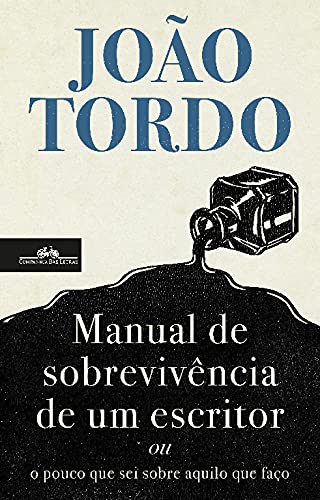
As you can see, the front covers are wonderful. Initially, as I browsed Bertrand bookshop on Rua Ferreira Borges in Coimbra, I absolutely judged both of these books by their covers. I think the covers are classy and creative, communicating the tone and theme of the book. These books are for booklovers, and lovers of words. The typewriter on the de Carvalho book and the ink spill on the Tordo book are lovely details, as is the use of subtle, toned-down colours.
I thought twice about writing this post, because it may have limited appeal – the books in question are not translated into English. I wondered whether the ideal reader for this blog post is a Portuguese speaker who reads reviews in English. I’m hardly aiming at a wide audience. And yet…
And yet I believe that the highs and lows of creative writing are universal experiences, which any writer can connect to. João Tordo and Mário de Carvalho aren’t known in the anglophone world, but their knowledge and advice is valuable in any language.
First, a comment on the titles. Joao Tordo’s book translates as Writer’s Survival Manual or The Little I know About That Which I Do. It’s a great title for a book of its kind. It communicates the uncertainty of the writer: always using your skills, yet wondering how you are doing it, and whether you can do it again. All writers have imposter syndrome to some degree. As for the book by de Carvalho, I have to ask myself the question whether a book title has sounded so good in Portuguese and so awkward in English. Whoever Says the Opposite is Right: Letters Without Bullshit.
Tordo’s book is far more personal that de Carvalho’s. He shares the pain of failure, the struggle not just to write the book but to navigate the world of publishing. In parts it’s negative (Tordo describes the ardent aspiring writer as being “condemned to literature”). He tells stories of skirmishes with unscrupulous publishers, of the various writers’ retreats he has been to in France and America; about his journey to Brazil, and in all this how he found a way of bringing his imaginative ideas to the page.
While de Carvalho casts his net wide to incorporate reflections on Socrates, Shakespeare, Rabelais or Homer, Tordo often uses examples from his own body of work. He shows the genesis of an idea, and how it finally ended up as a book, after taking several twists and turns along the way. I mentioned that both writers have achieved critical success. Tordo especially writes about living without the luxury of the high income which great commercial success can bring. His attitude is very pragmatic: if a well-known writer needs to earn extra money by teaching creative writing, then so be it. He points out that there will always be someone who is a better writer than you, always someone who sells more, often someone who starts much later than you and quickly overtakes you in terms of sales, celebrity or prestige.
There is advice from Tordo on editing (“The process is of humility, not of humiliation”) and on the relation between reading and writing: the writer needs to “read like a writer” and consequently “write like a reader”. His advice seems more grounded than that of de Carvalho.
De Carvalho’s scope is impressive, bringing in the whole history of literature, especially through the Greeks, then the great names of European letters. Some advice is very direct. He tells the aspiring writer that reading half a dozen stories by Chekhov is more valuable than countless writers’ workshops. He extols the literary value of ripping up conventions, while acknowledging that as readers we all like convention. He says that there are no dogmas or impositions in what he advises. Both de Carvalho and Tordo emphasize the freedom of the artist to create. Tordo links it to childhood play – the novelist is like a child still at play with toys.
It’s long established that for writers in the English language there are some key books on writing: Stephen King’s On Writing, Strunk and White’s The Elements of Style, and several others depending on who you ask. For the aspiring Portuguese writer, these books by Tordo and de Carvalho will become classics. I doubt whether the average English reader will ever have the chance to read them. I’ve never seen a Tordo novel in English, despite his success in Portugal and France. An Amazon search shows one Mário de Carvalho book in translation, available second hand, but currently out of print.
Acknowledging the literary landscape of another culture gives us the knowledge that there is so much going on ‘out there’. Writers are writing, readers are reading. The passion we have for books, for stories, and for exploring the human heart is universal, despite language or borders.







 Russell Thompson