John Dickson Carr (1906-1977) was the king of the impossible crime story, or the locked-room mystery. This sub-genre of crime is just as much about how it was done than who committed the crime. A body is found in a room which is locked from the inside. How did the killer enter and leave? This is the type of story in its essence.
The number of impossible crime scenarios a writer can come up with is endless. However, once an impossible crime is thought up, a plausible solution must also be worked out, and this is the challenge for the writer. If a writer writes himself into a corner, he must write himself out if it again.
I have to admire John Dickson Carr’s clever plotting. I also enjoy the darker and more sinister details he adds, which sometimes hint at the supernatural. In The Hollow Man a man leaves no footprints in the snow before vanishing, and there is a hint that someone has come back from the dead. The settings are often old castles and houses, which add a touch of the gothic. John Dickson Carr made the impossible crime his speciality, creating intricate and clever plots to amaze readers and confound their expectations. However, there is a ‘but’ coming…
At its worst, I find Dickson Carr’s writing clunky and confusing. Sometimes characters say odd things, sometimes scenes are described in such a way that the reader has to read it again to understand exactly what’s going on. The reader of crime novels should find the mystery taxing, not the prose style. Many of the characters are two-dimensional (the pretty young woman, the man-about-town, etc).
Another problem Dickson Carr has is that his characters aren’t likeable (of course, I’m writing subjectively, and others may disagree). Take his detectives Gideon Fell and Henry Merrivale. Both are bumbling and sometimes cantakerous, but neither is very endearing. Contrast this with Poirot, who is conceited and absurd, but also a reassuring presence who we like, despite all his eccentricities. When Poirot shows up half way through Sad Cyprus, the reader feels they are on safe ground all of a sudden. Here comes Poirot, and everything is going to be all right. When Henry Merrivale turned up to solve the crime in The White Priory Murders, with sexist comments and ill humour, I didn’t get such a feeling.
John Dickson Carr’s plots are sometimes brilliant, and its on this that his reputation rests. His short story ‘The House in Goblin Wood’ gives us a mystery about a girl who goes missing from a house, and then reappears again without explanation. Years, later in adulthood, she revisits the house, and goes missing from a locked room once again. The story is intriguing, macabre, and ingenious in its plot. There is an explanation, and a clever one at that. (I will apply my previous criticisms to this story: the central detective – in this case Henry Merrivale – acts erratically, and the other characters say and do odd things which brought me out of the story.)
The author’s most famous book – and the most famous of all locked-room mystery stories – is The Hollow Man. This has John Dickson Carr’s regular mix of ingenious plotting and macabre story elements. I have read and enjoyed this book recently. However, it wasn’t my first attempt. I have a memory of being fifteen years old, lying on top of a canal boat one summer, trying to get into this book, but struggling to. I eventually gave up. More recently, I gave up on an audiobook of Death Watch, which starts with the murder, but just throws all the characters and clues at you in the first chapter, which doesn’t draw the reader into the story.
I believe that this obstacle is one that has prevented John Dickson Carr from being a truly popular writer. He is very well known among fans of crime fiction, but his popularity has not reached as far as some of his contemporaries (think Christie, Sayers, Chesterton, etc) who were read by readers who only dabbled in reading the genre. John Dickson Carr’s books are for crime fans. I recently read The Honjin Murders by Seishi Yokomizo. This Japanese crime novel from 1973 explicitly mentions John Dickson Carr in the text, and delivers its own locked room mystery. He is also referenced in subtle ways in the series Jonathan Creek, written by David Renwick, a lifelong fan of the locked room mystery. As I’ve mentioned it, I must recommend Jonathan Creek not just as a series of fantastic locked-room puzzles, but as a generally entertaining series (with charming, likeable characters, and some great gags).
I have titled this piece ‘The Impossible Case of John Dickson Carr’ because he leaves me with a conundrum. I love impossible crimes and intriguing, macabre mysteries. But I am constantly frustrated by his awkward scenes and odd dialogue. I enjoyed The Seat of the Scornful, and also The Black Spectacles, which is a personal favourite of mine among his books. I will continue to read John Dickson Carr, but I am left with the feeling that although I admire the mysteries (indeed, I am inspired to write my own locked-room mystery), I will never warm to his world as I have to the worlds of other writers. Dickson Carr has wit, he has plot ingenuity, but he lacks a common touch, the ability to draw any reader into his books.
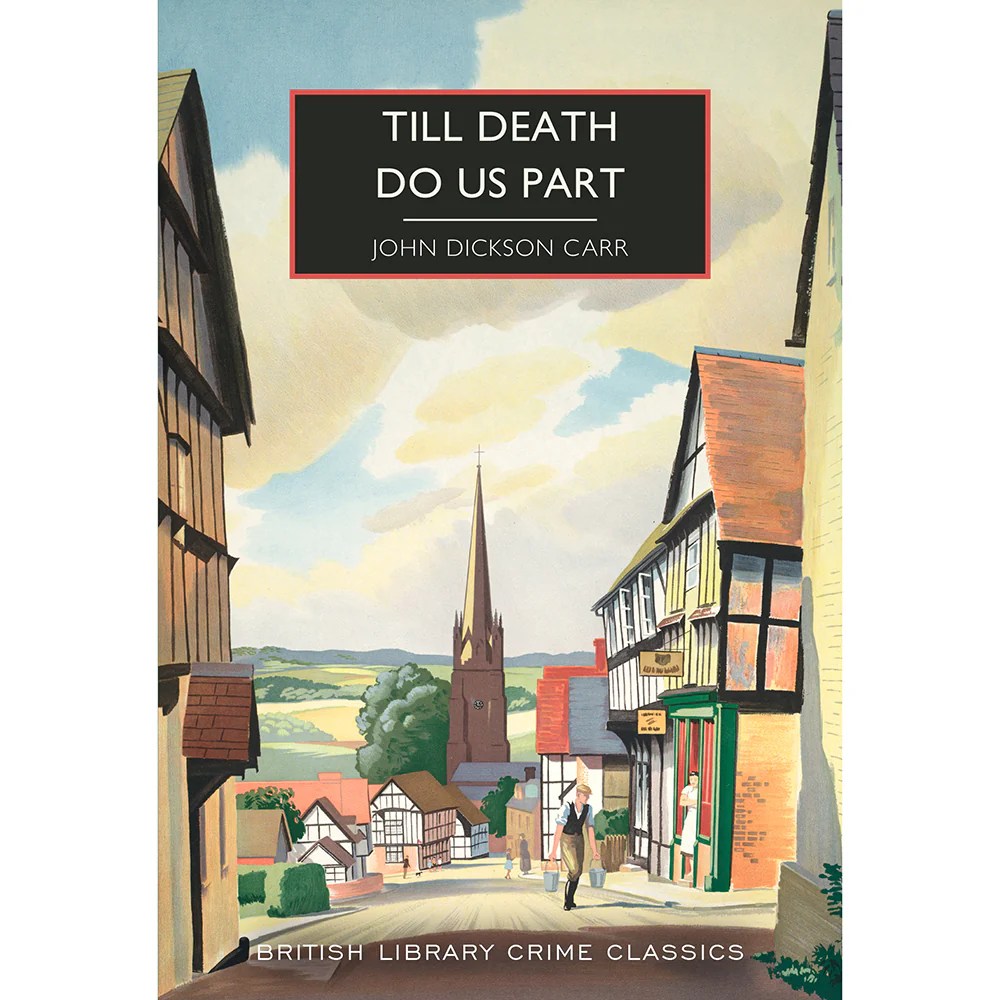
Of course, this is subjective, and a true John Dickson Carr fan may put a wonderful case forward for him. I will keep reading his books (I notice that the British Library crime series have at least one more coming next year), and I will continue to be impressed by his plots. But he will never be a writer I am truly fond of, only one I admire. Perhaps that is enough.



Note: The crime fan and pedant in me would like to point out a common mistake. A ‘locked room’ mystery is not the same as a ‘closed circle’ mystery. Even crime writers themselves mix this up sometimes (I won’t mention names!) A ‘closed circle’ mystery is where the murderer can only be one of a certain number of people (think And Then There Were None). A locked room mystery is an impossible crime, a crime in which the murderer has seemingly miraculously entered or left the scene of the crime.
 Russell Thompson