The Portuguese town of Póvoa de Varzim is a short tram ride from Porto. Its beach is popular on sunny days, its outdoor café terraces bustling with day trippers who have taken the red line tram north to escape the city. Tourist shops selling buckets, spades and parasols can sit alongside small shoe repair shops (sapatoeiras) for locals, and overdeveloped blocks of flats are just round the corner from elegant, historic squares.
In 1845, Eca de Queiros was born in Povoa de Varzim, which at the time was little more than a fishing town. Eca de Queiros is a well-known name in Portuguese literature, and indeed outside of it. His name is known within Portuguese culture in general, and his famous novels, such as Os Maias and The Crime of Father Amaro, are the kinds of books that meet Alan Bennett’s famous definition of a classic: a book everyone thinks they have read, but probably have not.
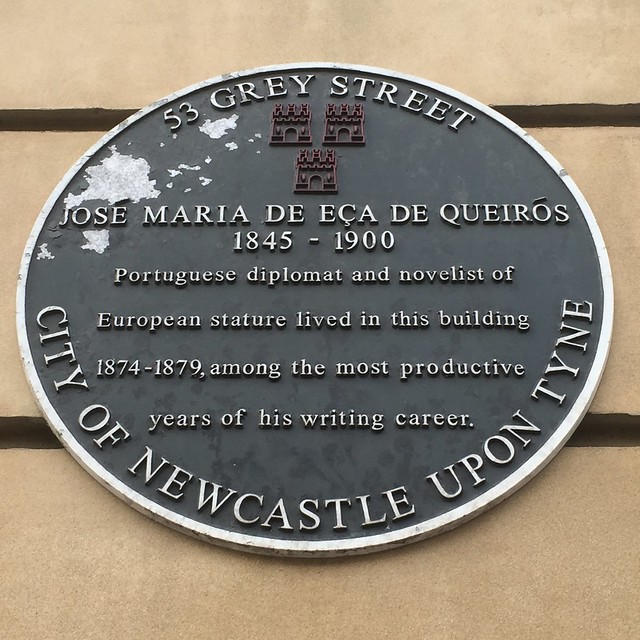
A curiosity in both the histories of Portuguese literature and the city of Newcastle, is the fact that Eca de Queiros spent five years living at 53 Grey Street in Newcastle. He travelled widely during his career as a diplomat, and held posts in Havana, Bristol, Newcastle and Paris (and it’s not often those four places are named together). At the time both Bristol and Newcastle were key port cities, made prosperous by trade, and in the case of Newcastle, coal mining.
I would love to know how many people notice the plaque on the great Georgian thoroughfare of Grey Street, as they walk from the Metro station towards Tyne Bridge and the river. It seems to me that it represents an obscure chapter of history which can become easily lost.
For an English reader, some of Eca de Queiros’ books are available in translation, but they would have to be sought out. He is basically unknown in the English-speaking world. I have read various of his short stories in Portuguese, and own a copy of his detective novel, which I have written about in a previous post. Despite his admiration for Dickens, Eca de Queiros was never going to find such popularity himself. This is partly, in my opinion, because his books are just not as commercial or engaging as Dickens’, and also because as a Portuguese-language writer he had a much smaller market.
Even today, the highly respected and award-winning writer João Tordo comments on the difficulty of being a Portuguese-language writer. Or, as he put it, a writer in a country where reading isn’t such a popular past time. There is, of course, the fact that as Portugal has a population of 11 million, a Portuguese-language writer would need to hit the Brazilian market to reach big numbers in their native language.
I would recommend Eca de Queiros’ birth town of Póvoa de Varzim if you are ever in Porto and fancy a day trip to the beach. It is only a tram ride away. These are not, however, the tranquil beaches of the southern Algarve. It is the rough Atlantic coast of the north. It makes me wonder, considering the harsh but beautiful English north-east coast, whether Eca de Queiros might have felt somewhat at home in Newcastle after all?
 Russell Thompson