Adverbs and Adjectives: The Writer’s Enemy

Trigger Warning: For those of us who love language and don’t like to see it treated with cruelty, the following post contains some upsetting material, in which several rules of good writing are broken. The post also features adverbs from the beginning.

‘It’s about time I wrote a blog post,’ I thought to myself, tiredly, as the bright sun peaked over the flat horizon to signal a crisp, Autumn morning.

So I sat down at my computer, reluctantly, pondering whether to write about one of those thrillers I had enjoyed so much recently, or whether to dive enthusiastically into some other subject matter, such as my love for the wonderful Anthony Trollope, the famed Victorian writer who wrote so prolifically.

As I sat there, thinking about what to write, I took a sip of coffee from the big mug in my hand. I slurped the hot liquid greedily as an idea struck me. I began writing furiously, putting down all my thoughts on that favourite topic of writers: the techniques and building blocks of writing.

Suddenly there was a knock at the front door. I looked out of the window, curiously, to see who the visitor was. It was a young man in a black coat. He had a medium-sized beard and brown eyes. He stood at the door impatiently, a parcel in his hand.

‘What’s this?’ I said to myself, quietly. ‘I don’t remember ordering anything.’ Then a thought sprang energetically into my head. Of course! I had recently ordered the book The Elements of Style, along with Stephen King’s On Writing. But why, I asked myself, frowning deeply, didn’t the delivery driver just post it through the door?

I opened the door angrily, unhappy at being interrupted. The delivery driver stood there sheepishly, holding the parcel. ‘Your letterbox is very small,’ he said earnestly through his medium-sized beard. ‘I tried to push it through but it kept getting stuck.’

‘Don’t worry,’ I said, kindly.

Suddenly I saw the parcel which he was reluctantly proffering. In his aborted attempt to put the parcel through the letterbox, he had damaged the package. What was left was a mangled and misshapen duo of books, contorted and ugly.

Isn’t it awful, I thought to myself, sadly, when someone takes something great, like printed words, and turns it into a complete mess? I promised solemnly not to be guilty of such a crime.

Inspiration and Perspiration: The Writer’s Life

Earlier this year, I spent a few days on the Lisbon coast. I stayed in Cascais, one of the towns along the so-called ‘Portuguese Riviera’, a stretch of coast whose beautiful beaches, south-facing aspect, and frequent sunny days make it a popular holiday destination.

I walked around its cobbled streets, walked across wide-open popular beaches, discovered hidden beaches in coves and gaps in the rocks, which led to secluded caves. These are the moments when the writer thinks ‘I could write a story set here.’ It’s a moment of excitement, a rush of creative possibility. As writers, we are drawn to such magical places – we ask the ‘What if…’ question, and a story emerges like a beautiful image not yet in focus. The characters, drama, and suspense are all there to discover.

The inspiration part is a beautiful period. Endless possibility, unlimited potential. But then comes the perspiration. Back home, away from the Portuguese sunshine, away from the chilled wine and the sound of waves lapping against the rocks, I have to sit down and write 80,000 words. No amount of dreamy ‘What ifs…’ will carry me through this task. Work, work, work. Write, write, write. That’s what it takes to make the wonderful ideas we have as writers into a novel that works. Maybe it won’t work at first. Then you have to fix it. That mean’s more work, more problem solving.

The dreamer says to himself ‘I could write a book set here.’ The writer gets the job done. It’s something we might struggle with a first, but practice and determination pay off. Look at all the writers filling up the top positions in the bestsellers charts. They all began by thinking to themselves, ‘What if…’, before getting to work and finishing the book.

Writing Routines

Whenever I listen to interviews with authors, I’m always interested to know their writing routines. I think this is of interest to both established and aspiring writers. When you start off with the aim of getting 80,000 to 100,000 words from your brain onto the page, the obvious question is ‘How shall I do it?’

Closely related to this are the questions ‘How many words can I write a day?’ and ‘How long does it take to write a book?’

The writer of commercial fiction is often contracted to publish a book a year. This means he or she may be writing the first draft of one book, while editing another book, and publicising yet another! You may wish to be a commercial genre writer, or you may wish to be more like James Joyce, who spent years on a book (and reportedly could spend a whole day on one sentence). Or Donna Tart, who has written few books, with long gaps in between, but has consistently been critically and commercially successful. What kind of a writer do you want to be?

The first full-length novel I wrote (and it’s one of those novels which will stay in a draw for now) was an historical novel of 140,000 words. It was too long, but I did get a manuscript request from an agent, which suggests it wasn’t awful. During the process of writing this book I learned how best to get words on the page, and what kinds of routine suits me.

During this time, my wife was working shifts at a local hospital, which meant sometimes she would have to start work at 7am. I got into the habit of getting up early with her, and using that time in the morning to write until I had to go to my own job for 9am. I found that I was never more productive than at this time in the morning. Even on days when I had a large block of time in, say, the afternoon, I seemed to lack the flow and clarity I found first thing in the morning.

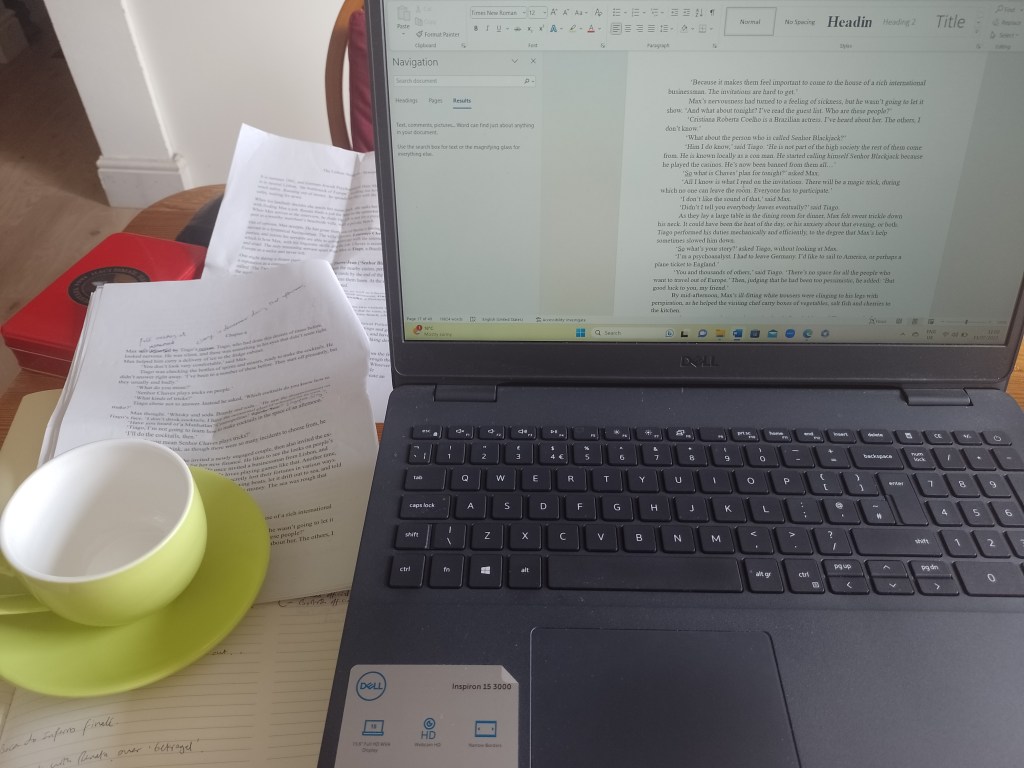
Thus, my writing routine was set. For some reason, I use a particular lime green cup and saucer on writing mornings, filled with strong black coffee. I wouldn’t call it superstition, but rather there’s something about the ritual of a routine that I’d prefer not to change if it works.

As I learned to rewrite and redraft, I found that this detailed work was best saved for later in the day. Early morning was where I found the creative spark, but not necessarily when I had the keen eye for detail needed for editing.

Famously, Anthony Trollope would write in the mornings before he went to his job at the Post Office. He would write 250 words each 15 minutes. Writing between the hours of 5:30am and 8:30am, that put him at around 3000 words per day. I heard an interview with Linwood Barclay, who during the writing of a recent novel found getting an Uber into town gave him a surprisingly productive time and place for writing. So during the writing of that book, he kept getting Uber rides into town.

I think another reason writers want to know about other writers’ routines is that we are insecure and want to compare ourselves. We ask ourselves the question, ‘Are others writing more than I am?’, or ‘Do other people find it as hard as I do?’ This suggests that no matter how experienced or professional a writer is, there is always a part of them that doesn’t know what they are doing. Creative processes are mysterious. It’s not like changing a bike tyre, or altering your boiler pressure, with step-by-step videos available on youtube.

Whatever you find works, whether it’s early in the morning or late at night, the key is consistency. If you are sporadic, or can’t find a routine, that word count will stay low. If you can get into a habit, even if you write a little at a time, you will be surprised at how the word count goes up and reaches your target.

The Joy of Entering Literary Worlds

One of the joys of reading is to escape. Not just escape, but to have the chance to explore new worlds. I don’t often consider this aspect of reading. More often I point to my love for language or my interest in human psychology and behaviour. I also love story, which means I love the thrills of the plot racing forward, and the cliff-hangers that make us say “Just one more chapter!”

I always associated escape and the building of ‘literary worlds’ with science fiction and fantasy. In the corner of Oxford where I live there are no shortage of famous homes and landmarks with links to such authors. I regularly walk past J.R.R. Tolkein’s old house on my way to work. I used to walk past the grave of C.S. Lewis every time I took my daughter to pre-school, cutting through the grave yard of Quarry Church. When I go for a walk I often find myself walking past the entrance to the house of the late sci-fi author Brian Aldiss.

(I will add here a detail which will be shocking to Terry Pratchett fans. As a teenager I joined a huge queue at WH Smiths in Nottingham to get a book signed by Terry Pratchett. I was fascinated by all things bookish, and knew I wanted to write. To meet an actual writer was thrilling. I loved the illustrations on the covers of Pratchett’s books. However, I just couldn’t get into the books. They weren’t my thing. To this day I have a signed copy of Good Omens, which is inscribed with the words: “To Russell, We made the Devil do it! Terry Pratchett”. I’ve had it for over twenty years and have never read it.)

Fantasy and sci-fi were never my kinds of genres. Yes, I dip into Tolkein and dabble with John Wyndham, but I’m never at home with the genre. For me it is always crime fiction, thrillers, and sweeping Victorian novels. These are the books I immerse myself in. They are just as escapist and immersive as any other created world. When I read Georges Simenon, I am in Paris, joining Maigret for his lunchtime sandwich and beer. When I read Agatha Christie, I’m in the world of picturesque villages with dark secrets, or I’m entering Poirot’s world of glamourous holidays and seemingly endless leisure time (not to mention income).

The word ‘escape’ can have unhealthy connotations. To escape reality can be harmful, hence ‘fantasy’ being on Anna Freud’s list of psychological defence mechanisms. However, there is a difference between the reader knowingly entering a fantasy world and the person who is detached from reality in response to the threat of psychic pain. We must remember Coleridge’s phrase on reading: the ‘willing suspension of disbelief’. The reader knows the difference between fantasy and reality, and fully understands the tacit agreement with the author: “You tell me something as if it’s true, and I’ll believe it as if it’s true, even though we both know it is untrue.” I will add to this that poetic truth exists outside of literal truth anyway.

Which other worlds do I love to be immersed in? I read crime fiction set in various parts of Europe: Martin Walker’s books set in the Dordogne, Donna Leon’s Venice books, the Sicilian Montalbano books, Ragnar Jónasson’s Iceland books, Tom Benjamin’s Bologna books, Ian Rankin’s Edinburgh books, and the list could go on. These books give us a literary version of a real place, which is, I suppose, quite different from being in the place itself. We may get a strong cultural and geographic flavour of the setting, but where the line between fantasy and reality is, I don’t know. My own books, set in Portugal, offer an authentic sense of the city of Coimbra, but it will always be through my eyes and with my observations. I will people the city with characters I want to include, and will leave out the parts I have no interest in.

Since childhood I have been interested in Joan Aiken’s Wolves of Willoughby Chase series, which are historical adventure stories, but which take place in an alternative 19th century history that never existed. Oh, and England is overrun by wolves. This is a world to escape into. I’ve recently been reading Louise Hare’s Miss Aldridge Regrets and Tom Hindle’s A Fatal Crossing, both of which are historical crime novels set on luxury ocean liners. Both books offer a whole world to enter into – glamour, luxury, and a sense of being away from the humdrum details of everyday life (such as having to call someone to fix your boiler).

While I was at university I read Our Mutual Friend by Charles Dickens. This brick of a book, brimming with characters, and encompassing the filthy backstreets of London as well as the smart dining halls, also offered me a world to explore. Yes, it was London; yes, it was nineteenth century; but it was also the world of Dickens. I came to believe in those characters. I sometimes go back into that world when I’m in the mood. My bookshelf is packed with so many possibilities for exploration and escape that I see no reason why my passion for books, stories, words and worlds will ever be satisfied.